
2023 was a year of mixed fortunes. Some years, bees in the Meridian area are active from the end of February but this year, they didn’t really get going until the end of March. However, in April, May and June the weather was generally favourable and if you were lucky enough to have colonies with a strong foraging force ready at that time, they were able to add honey very quickly.
July and the beginning of August were mostly wet and even cold at times which impeded the collection of nectar at that crucial time. It was noticeable how much of the stores collected earlier in the year the bees consumed during that period.
Like other members, we were harvesting honey in the middle of August. We found some crystallisation on the combs but the honey that was easier to spin out, was darker and stronger in flavour than in recent years. In the end, we managed a respectable harvest and we were pleased with the honey’s floral flavour.

Whether you harvested or not, let’s make sure our bees have sufficient food to see them through winter. This page provides guidance on the level of stores required with links to trusted sources.
Now that the active season is coming to an end, it’s time to think about getting ready for 2024 with all the hope and promise that brings! This page summarises the preparations you can make this autumn and winter in order to start next year in the strongest position.
August
August is said to be the start of the beekeeping year because it’s when your winter preparations begin. The more care taken in Autumn, the more likely you are to still have bees the following Spring!
One thing’s for sure, the natural cycle of the honey bee colony and more particularly, the weather, dictates the precise schedule of work throughout the year. So let’s start at the very beginning…
Swarms in August are unlikely but not unknown. Fortnightly inspections of colonies should suffice at this time of year and swarms should completely cease by the middle of the month at the latest. Most hives should now have cast out their drones.
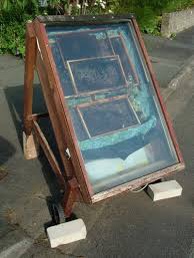
Honey removed after the main summer flow is harvested this month and processed. If you have already taken your crop, you can remove the queen excluder now as all further stores will remain with your bees. Wax collected throughout the active season can be rendered. A solar extractor is a very efficient way to process wax using the natural energy of the sun.

For those heading out to the forest for heather honey, strong colonies led by a young queen can be prepared (with some reserve stores) but with ample empty comb.
The heather flow is most often at its peak in the second week of August.
Usually, Meridian organises the ‘heather migration’ as an Association as siting hives in the forest must be pre-arranged and agreed. Bees are booked for the forest in April or May and the forest license begins at the end of July and expires 6 October. Currently, there’s an issue with public liability insurance and the usual migration to the forest has been suspended.
As the queen’s laying starts to reduce, now’s the moment to check for heavy late-summer varroa infestation by checking natural mite drop. Counting varroa.
Assess your colonies and start to unite weaker ones in preparation for winter. Uniting colonies.
If drones are still available in some colonies your bees may decide to supersede their queen at this time of year. If it happens, a key benefit is your bees will go into winter and next year with a fertile new queen. It’s important that you know how to spot supersedure cells (at any time of year) and to leave your bees alone to complete the process. Queen cells and how to identify the different types.

Queens are replaced either by swarming or by supersedure. This is an entirely natural process and is usually uneventful. Remember, unlike a typical swarm cell situation, supercedure cells are usually few in number, often just two or three.
September
Any measures taken under Integrated Pest Management should have prevented a large varroa build-up but now is a good time to check mite levels and if your honey has been removed, apply varroa treatment if needed.
Temporary notice: The varroa calculator is currently not available on the new Beebase website. Meridian has asked the National Bee Unit to migrate it over as soon as possible as it’s one of the most useful tools on the site. In the meantime, we can use the graphs available in this document which can be accessed here.

Chemicals applied should be used strictly in accordance with the manufacturer’s instructions. When treatment has been completed, remove residues. Leaving treatments in place can allow mites to become resistant to them. Some treatments can be continued until October.
It’s not too late to assess your colonies and unite weaker ones in preparation for winter. Merges can be done easily using the newspaper method and should be completed as soon as possible.
Place the weaker colony directly on top of the stronger one, separated only by a perforated sheet of newspaper. Full instructions can be found at Dave Cushman

The rate at which your queen(s) is laying will have slowed down by now. The colony’s population will reduce from its summer peak (around 60,000 bees) to about 10,000 bees and the queen will be laying a physiologically different type of bee. They’re called Winter Bees or Fat Bees and instead of living about six weeks as the workers do in summer, they live about six months to see the colony through winter and to get them going again in the spring.
Feeding
Feed thick sugar syrup to those colonies low in stores (1kg of sugar dissolved in 630ml of warm water is the desired strength) but Autumn feeding must be completed by the end of September to allow the bees to ripen the feed and seal it before the cold weather begins.
Non-ripened feed may ferment and lead to dysentery. Only use white, granulated sugar to make your feed as any other kind is harmful to the bees.

Feeding is best done whilst the colony is still strong and it’s warm enough for bees to move up into the feeder. They need to take down the syrup, invert it and store it properly in the comb.
An average honeybee colony requires about 20 kg of winter stores. A British Standard brood frame, when full of honey contains about 2.5kg. A 14×12 frame contains about 3.75kg. A super frame holds approximately 1kg. Therefore, your bees need the equivalent of 8 (or 6) brood frames of honey.

So, assess the existing colony stores and feed the required balance using sugar syrup. Beebase, feeding sugar.
Note: Beebase estimates that 1kg of sugar (plus an equivalent quantity of water) will create 1.25Kg of stores in the brood box.
Remember to wear a veil when you’re feeding your bees. They may not appear very active later in the month but they’ll still surge through the crown board if the feeder is disturbed. Most bees, particularly stronger colonies, become more defensive in the autumn; they’re protecting all those winter stores. Even on warm days, it’s worth wearing a long-sleeved shirt and trousers under your bee suit.
Robbing
Watch for signs of robbing – bees fighting or trying to enter a hive without meeting the guards. If robbing starts, reduce the entrance to one bee space using an entrance block and/or grass. This enables bees to guard the colony more effectively.

Whilst feeding, care should be taken to prevent robbing. It’s a good idea to feed in the evening and to reduce the hive entrance to small.
Robbing
Here is a short film showing robbing at our West End apiary last year. Denise visited the bees at the end of August and found robbers gaining access through a leaky roof. She replaced the roof and reduced the entrance but as the robbers already know the location of the hive, they continued to attack it. If the bees still cannot defend themselves, the hive can be moved as a last resort.
Wax collected throughout the active season can be rendered and if preferred, swapped for fresh foundation ready for next year.

September is also the time to start hefting hives to assess stores. This should continue periodically until the end of October as this will help you decide if fondant will be required later in winter.
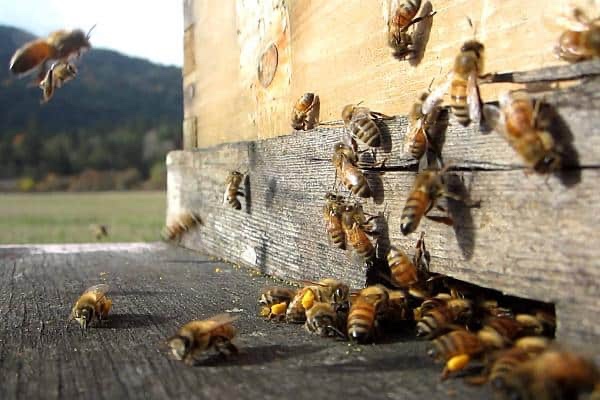
Beebase, autumn management in the apiary
October
If you haven’t done so already, remove the queen excluder from your hive(s). Removing the excluder allows your bees to access stores in the super. The winter cluster will not move up into the super if their queen is unable to join them.
Remove empty supers from the hive. These can be stored in a shed if you have one or in a stack outside, tied down to protect from winds. Any necessary repairs can be carried out in winter. If any of the supers still has a little residual honey, place them under the brood box. Bees don’t like stores below them so will eat that honey first, cleaning the comb as they go! The empty super can then be removed before winter sets in.
If possible, it’s a good idea to reorganise the frames of stores in your brood box. If you have stores on either side of the brood nest, put all the stores together on one side. This helps to prevent isolation starvation*.
If you are using National equipment set warm way, put the stores to the back of the box (furthest away from the entrance) as this replicates how bees would store their food in a wild nest; i.e. at the back of the nest furthest from the entrance.
* Isolation starvation. There’s nothing more depressing for a beekeeper than isolation starvation. You open the hive for your first inspection of spring only to find the bees have starved despite the presence of plenty of stores. What happens is, the bees start in the middle of the box and move in one direction consuming the honey as they go. Then, the weather gets too cold for them to move back in the opposite direction towards the ample stores on the other side of the box. The result, a dead colony despite plenty of stores remaining. This can be prevented by placing all the frames with stores together.
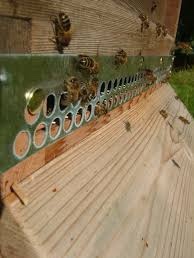
Make sure your entrance blocks are set to the smallest gap. Some blocks can be placed upside down and if you can do that, it helps prevent the entrance becoming blocked by dead bees over winter.
If your hive entrance is no more than 7mm high, mice cannot gain access. Otherwise, fit mouse guards to all hives at the beginning of the month and make a final check for winter security. Are your boxes fitted tightly together? Are roofed well-fitted and dry? And it’s not too early to strap-down your hives.
Feeding of syrup should have ceased by now as your bees will need time to process the syrup into stores and cap. Unsealed stores can ferment and cause dysentery.
Continue to monitor the weight of your hives as warmer weather can keep the bees active resulting in them depleting their stores. If you have any nucs in your apiary, watch them carefully as by definition, there is less space in the box for the bees to store food. You can place fondant on the nucleus perhaps earlier then you might for your full-sized hives.
Continue to watch colonies for signs of robbing by wasps and bees. Reduce entrances if they have a been set wide and move heavily-affected colonies as necessary as a last resort. Wasp traps may be needed.
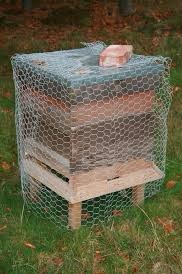
Protect hives from woodpeckers by wrapping them in chicken wire.
You can insulate above the crown board with materials like foam or polystyrene but carpet underlay or similar can be used. This helps to limit condensation in the hive.
Chemical treatments for varroa should be completed by the end of the month. Mites become resistant to chemicals if the same treatment is used year after year or if it is left on the hive longer than recommended by the manufacturer, particularly for pyrethroid acaricides like Apistan and Bayvarol.
You can check your mite count by inserting your counting board and checking against the Varroa calculator on Beebase. Counting varroa. As a general guide, a daily mite drop of eight or above would suggest treatment will soon be needed. A shook swarm in spring perhaps or a treatment of Oxalic acid at the end of December (after a period of frosty weather) as the treatment is best applied when the queen has stopped or reduced laying.
October’s a good time to trim back vegetation which has been snagging your veil and generally getting in your way all summer! It’s not a bad time to start cleaning your equipment either as the weather’s not too cold but the cooler conditions make scraping off propolis much easier.
November

Winter provides a good opportunity to clean and repair your equipment. The National Bee Unit’s fact sheet on hive cleaning and sterilisation provides a useful checklist of things to do. The fumigation of comb for reuse is also best done in winter. Although cleaning equipment doesn’t always seem attractive in the cold of winter, having your equipment ready for spring is always preferable.
Periodic checks should be carried out to ensure hives have not been disturbed by weather, critters or vandals.
Do not disturb the bees.
If treatment for varroa with oxalic acid is selected, this is the month to apply it. If correctly used it involves minimum disturbance to your bees.
Winter

Hefting of hives is recommended throughout winter to monitor stores or a quick visual checks under the crown board can be made every three weeks or so.

If bees are short of stores and likely to starve, fondant can be placed over the crown board feed hole. The crown board may need turning to position a feed hole over the bee cluster. Bees require water, often taken as condensation within the hive, to make use of candy.
If there’s snow, don’t remove it from hive entrances but clear it off roofs. Bees are best left lightly imprisoned in bright snowy weather because sometimes they come out and can be chilled on clear frosty days.
Towards the end of winter, check natural varroa drop in case spring treatment is needed for heavily infested colonies.
 Meridian Beekeepers’ Association