
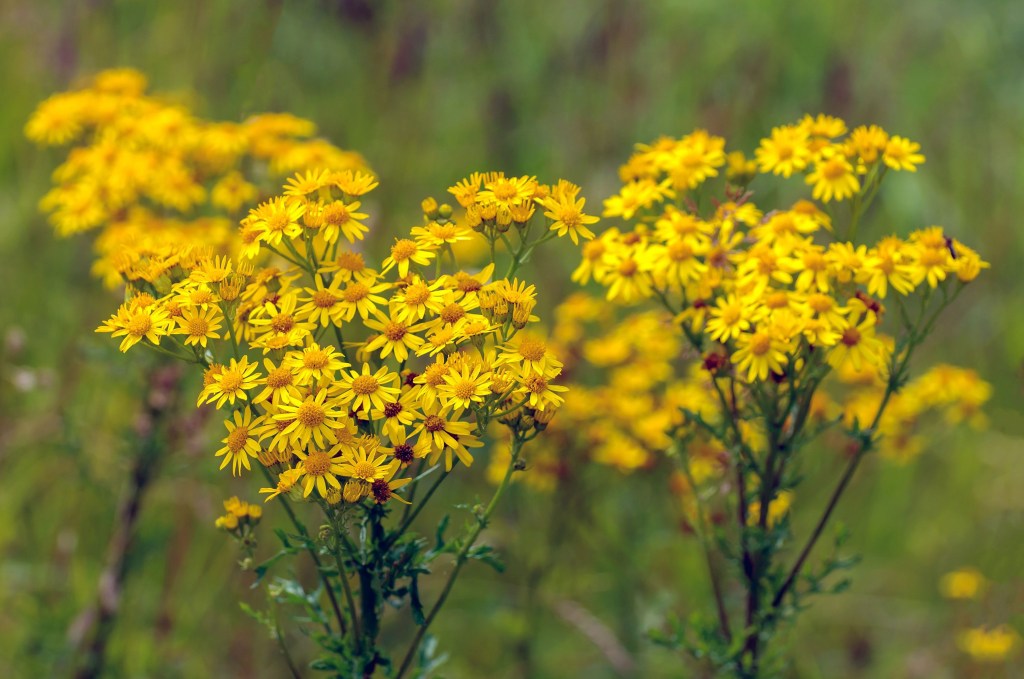
Ragwort (Senecio) is a tall field plant which grows to 90cm high and bears large, flat-topped clusters of yellow daisy-like flowers from June to October. There are nineteen species of Ragwort found wild in the British Isles but most of these are garden escapes or other introductions.
Common names for ragwort include common ragwort, stinking willie, tansy ragwort, benweed, St James’ wort, stinking nanny/ninny, staggerwort, dog standard, cankerwort, and stammerwort.
Ragwort is one of the most divisive plants in the countryside. It contains chemicals that are toxic to livestock and it has been blamed for many deaths of horses and other animals. Yet, conservationists say it’s a native wildflower vital for pollinating insects. The most common variety is Senecio jacobaea, Common Ragwort or Stagger Weed. It is a native species that thrives on bare ground where thin vegetation allows the development of seedlings.
Experts say that once Ragwort is established on suitable land, it can be difficult to manage. A single plant contains thousands of seeds and these can disperse into fields. Many farmers take preventative measures to reduce the risk of Ragwort spreading because the plant contains toxins called pyrrolizidine alkaloids. These, in sufficient quantities, can cause liver poisoning in horses and other livestock. It is a cumulative poison which means it builds-up in the animal’s body over time eventually leading to the rapid onset of symptoms before death. However, the symptoms are variable and resemble those of a number of other diseases. The lethal volume of Ragwort for horses is around 7% of body weight. Cattle are also prone to poisoning but sheep are thought to be less susceptible.
However, there’ another side to the story. The charity Buglife says that ragwort is a long-standing and important part of our native flora in Britain. Over thirty species of bee, beetle, other insects and fungi are supported by Ragwort including the Daisy Carpenter Bee, the Cinnabar Moth and our own dear Honey Bee. Just look at these clips from a spring apiary meeting; Denise had just successfully completed two Bailey Comb changes and the bees had built their new comb using nectar gathered from the plentiful local supply of Ragwort; have a look! Even the wax is Ragwort yellow!
Ragwort therefore has significant benefits to the environment and whilst farmers understand it can be dangerous to their livestock, many recognise Ragwort’s importance to biodiversity and don’t advocate blanket removal.
These days, farmers usually apply the herbicide glyphosate to Ragwort. However, the use of glyphosate is controversial; the World Health Organisation (WHO) has concluded that glyphosate is “probably carcinogenic” to humans and the herbicide has been the subject of several court cases around the world relating to cancer. Non-chemical options for preventing the spread of the plant are limited, though Countryfile editor Fergus Collins remembers being paid to pull Ragwort from farmland in Somerset as a teenager. Conservation organisations such as Friends of the Earth, would prefer the affected area to be fenced off and the plants allowed to go to seed.

While there is consensus that Ragwort poses some threat to domestic animals, it is difficult to assess the actual level of danger and impossible to say how many horses and other animals have been affected in the UK without more detailed research. Therefore, conservationists argue that removing a native wildflower impoverishes our natural world and should not be done. To find out more about ragwort, The British Horse Society provides an advisory ragwort toolkit online.
Oxford Ragwort

Travel West from Oxford on the Great Western Railway and you’ll see distinctive yellow flowers on the edges of tracks and verges. Although at first glance it looks like the Common Ragwort that causes such anxiety for equine owners, it is in fact Oxford ragwort (Senecio squalidus) a species introduced from the slopes of Mount Etna in Sicily in the late 17th century. After escaping from Oxford Botanic Garden, it has spread to most parts of the UK, where it favours disturbed habitats, such as building sites, roadsides and beside railway lines.
 Meridian Beekeepers’ Association